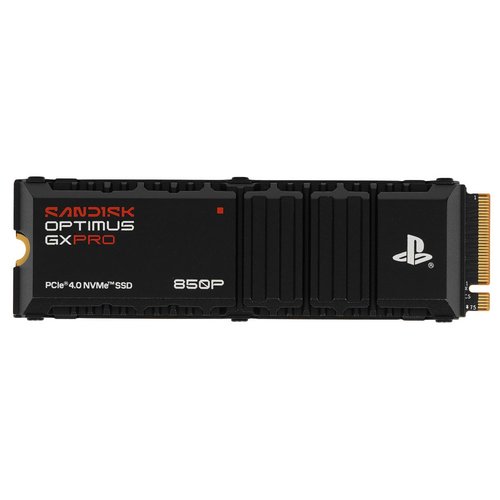
aluminum radiator, MBTF (mean time between failures) up to 1,750,000 hours, compatible with PlayStation 5
Dimensions
Length
80 mm
Width
24.46 mm
Thickness
9.89 mm
Weight
24 g
Description
The 1000 GB M.2 NVMe SSD Sandisk Optimus GX PRO 850P [SDSG81100TAH] is made in a standard 2280 form factor. It is designed for installation in desktop PCs and gaming consoles. The storage capacity of the drive is 1 TB, which is enough to store 200 hours of Full HD video or 200,000 photos. A TBW of up to 600 TB at a DWPD of 0.33 allows rewriting up to 330 GB of data daily. The mean time between failures is 1.75 million hours. The PCIe 4.0 x4 interface with NVMe protocol support delivers sequential read speeds of up to 7300 MB/s and write speeds of up to 6300 MB/s. This allows transferring 50 GB files in 8-9 seconds.
In 4 KB random block operations, the performance of the 1000 GB M.2 NVMe SSD Sandisk Optimus GX PRO 850P [SDSG81100TAH] reaches 800,000 IOPS for read and 1,100,000 IOPS for write. This ensures fast loading of the OS, games, and heavy applications. The drive is based on 3D NAND memory with a density of 3 bits per cell, which is resistant to intensive workloads. An aluminum heatsink dissipates heat and prevents transfer speed drops when copying large files.