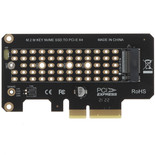
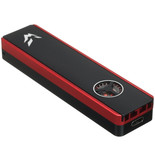
aluminum radiator, MBTF (mean time between failures) up to 1,750,000 hours, compatible with PlayStation 5
Dimensions
Length
80 mm
Width
24.46 mm
Thickness
10.31 mm
Weight
30.4 g
Description
The 4000 GB M.2 NVMe Sandisk Optimus GX PRO 850P [SDSG81400TAH] SSD is designed in a standard 2280 form factor. Dimensions of 80x24.46x10.31 mm make it suitable for installation in desktop PCs and gaming consoles. The 4 TB capacity is sufficient for storing a collection of heavy games, a high-resolution video archive, and professional software. A TBW of 2400 TB at a DWPD of 0.33 allows overwriting more than 1 TB of data daily.
The 4000 GB M.2 NVMe Sandisk Optimus GX PRO 850P [SDSG81400TAH] SSD features a PCIe 4.0 x4 interface with the NVMe protocol, enabling data read speeds of up to 7300 MB/s and write speeds of up to 6600 MB/s. Thanks to this, copying 50 GB files takes only 7-8 seconds. When working with 4 KB random blocks, device performance reaches up to 1,200,000 IOPS for reads and 1,100,000 IOPS for writes. This speeds up the loading of applications and game textures. The device is based on 3D NAND memory architecture, which is resistant to constant data overwriting. An aluminum heatsink dissipates heat and prevents thermal throttling during prolonged workloads.