compatible with MSI Claw, compatible with Microsoft Surface, MBTF (mean time between failures) up to 1,750,000 hours, compatible with Steam Deck
Dimensions
Length
30 mm
Width
22 mm
Thickness
2.38 mm
Weight
2.8 g
Description
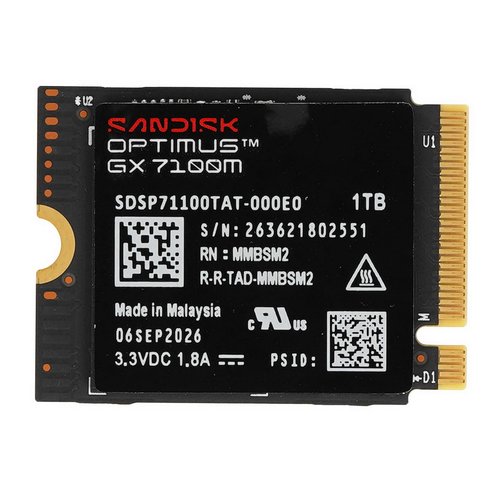
The 1000 GB M.2 NVMe drive Sandisk Optimus GX 7100M [SDSP71100TAT] is built in a compact 2230 form factor. It has dimensions of 30x22x2.38 mm and is suitable for installation in handheld gaming consoles, ultrabooks, and mini-PCs. The storage capacity is 1000 GB, which is sufficient for storing media files, work software, and games. The maximum write endurance is 600 TB. Thanks to this, users can rewrite more than 300 GB of data daily.
The 1000 GB M.2 NVMe drive Sandisk Optimus GX 7100M [SDSP71100TAT] connects to the motherboard via a PCIe 4.0 x4 interface using the NVMe protocol, delivering sequential read speeds of up to 7250 MB/s and sequential write speeds of up to 6900 MB/s. This allows 50 GB files to be transferred in 7-8 seconds. When working with small 4 KB blocks, performance reaches 1000000 IOPS for reading and 1300000 IOPS for writing. This speeds up OS and application launches, as well as level loading in games. 3D NAND memory with a recording density of 3 bits per cell is resistant to wear from continuous rewrite cycles.