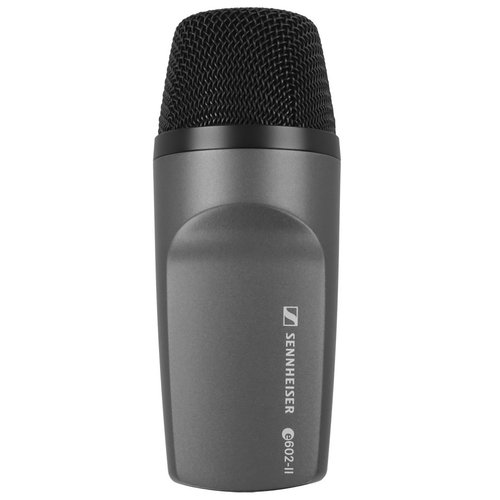
Characteristics Microphone Sennheiser E 602 II gray
General parameters
Type
microphone
Model
Sennheiser E 602 II
Main Color
gray
Extra Color
black
Number of Microphones Included
1
Basic microphone parameters
Operating Principle
dynamic
Polar Pattern Switching
none
Microphone Directionality
cardioid
Intended Use
instrument
Design
Design
pendant
Manufacture Material
metal
Technical specifications
Min Frequency
20 Hz
Max Frequency
16000 Hz
Impedance (Resistance)
350 Ω
Attenuator
none
Low-Pass Filter
none
Connection
Connection Type
wired
Cable Connector
XLR
Connectors
XLR
Functions
Headphone Volume Control
none
Sensitivity Adjustment
none
Monitor Volume Control
none
Microphone Mute Button
none
Headphone Output
none
Flexible Stand
none
Backlight
none
Stereo Recording
none
Memory Card Slot
none
Detachable Cable
none
Extra Contents
Spider Shock Mount
none
Suspension included
none
Pantograph
none
Wind Resistance
none
Pop Filter
none
Power
Phantom Power Requirement
none
Power Supply
none
Additional Information
Package Contents
case, documentation, rack mount
Dimensions and Weight
Microphone Width
60 mm
Mic Height
153 mm
Microphone Weight
318 g
Description
The Sennheiser E 602 II wired microphone in gray is designed for use with musical instruments, primarily low-frequency ones. Therefore, the model pairs best with bass guitars, tubas, violas, and drum kits. This is a dynamic microphone, so it is recommended for live performances rather than studio recording. The Sennheiser E 602 II features a cardioid polar pattern. This means it captures most of the sound from the front and only partially picks it up from the sides.
The microphone model features a suspension mount type, meaning it can be mounted on a floor stand as well as a wall or desk bracket. The microphone connects via a cable and an XLR connector. The maximum frequency is 16000 Hz. This is sufficient to accurately capture bass notes and pick up overtones at higher frequencies.