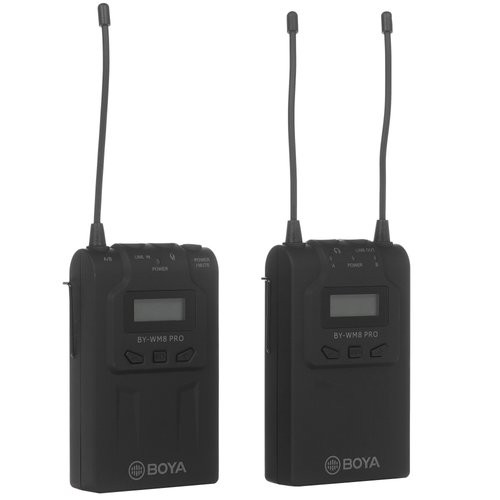
Characteristics Lavalier microphone system BOYA BY-WM8 Pro-K1
General parameters
Type
lavalier microphone system
Model
BOYA BY-WM8 Pro-K1
Main Color
black
Basic characteristics
Signal Reception Range
100 m
Audio Frequency Range
40 - 18000 Hz
Radio Frequency Range
576 - 600 MHz
Transmitter power
10 mW
Runtime
up to 6 h
Control via Mobile Device
none
Microphone
Number of Microphones Included
1
Type
lavalier microphone system
Operating Principle
capacitor
Microphone Directionality
omnidirectional
Min Microphone Frequency
35 Hz
Max Microphone Frequency
18000 Hz
Noise Cancellation
none
Microphone Power Supply
from transmitter
Microphone Sensitivity
-30 dB
Transmitter
Number of Transmitters Included
1
Mounting Type
belt
Transmitter Power Supply
AA batteries x2 pcs
Transmitter Weight
80 g
Transmitter Size
208 x 67 x 29 mm
Receiver
Outputs
jack 3.5 mm
Receiver Power Supply
AA batteries x2 pcs.
Display
yes
Distortion
0.5%
Receiver Weight
90 g
Receiver Size
208 x 67 x 29 mm
Power
Power Supply Voltage
receiver 3 V, 3V transmitter
Additional Information
Features
headphone output
Package Contents
microphone clip, microphone, documentation, wind noise protection, cable jack 3.5 mm - jack 3.5 mm x 2 pcs., transmitter, receiver
Description
The BOYA BY-WM8 Pro-K1 wireless microphone system is a dual-channel lavalier system designed for clear recording of two audio sources. The bodypack transmitter operates on two AA batteries. The receiver features a display, a standard audio jack, and a compartment for two AA batteries. The dimensions of each unit are 20.8x6.7x2.9 cm.
The BOYA BY-WM8 Pro-K1 kit includes a receiver, a transmitter, a clip-on microphone, an audio cable, and a windscreen. The lavalier microphone operates with a sensitivity of 30 dB. On fully charged batteries, the system can operate for up to six hours, transmitting a signal over a distance of up to one hundred meters.