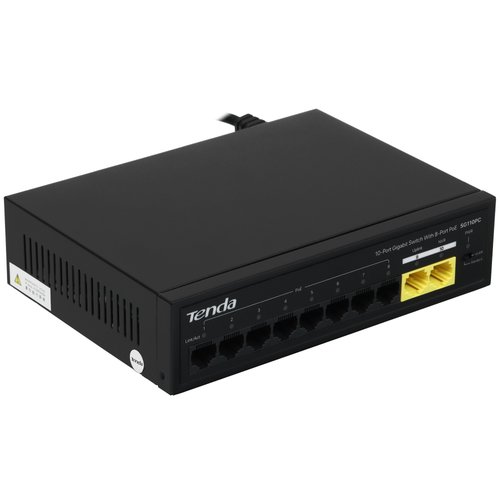
Switch Tenda SG110PC

#9114622

Switch Tenda SG110PC

[ports-10, uncontrolled, 10/100/1000 Mb/s, PoE, PoE budget 95 W] details

Not on sale
  • Characteristics
  • Feedback 0
  • Instructions and files

Characteristics Switch Tenda SG110PC

Classification

Type
switch
Model
Tenda SG110PC
Type
uncontrolled
Switching Method
store and forward
Switch Layer Levels
L2
Placement
wall-mounted, tabletop

Hardware

Cooling
passive

PoE

Support For PoE
yes
PoE Port Count
8
PoE Standards
PoE+ (802.3at), PoE (802.3af)
PoE Budget
95 W

Ports

Ethernet Port
1000BASE-T, 10BASE-T, 100BASE-TX
Base Data Transfer Rate
10/100/1000 Mb/s
Total Number of Network Switch Ports
10 x RJ-45
Number of Copper Ports (RJ-45)
10
RJ-45 Copper Connector Speed
10 x 1000 Mb/s
100 Mb/s Port Count
0
1 Gb/s Port Count
10
2.5 Gb/s Port Count
0
5 Gb/s Port Count
0
10 Gb/s Port Count
0
Number of SFP Ports
0
Combo Ports (RJ-45/SFP)
none
Console Port
none

Performance

MAC Address Table Size
4000
Internal Throughput
20 Gbit/s
Packet Processing Speed
14.9

Functionality and Software

Standards Support
IEEE 802.3at, IEEE 802.3, IEEE 802.3ab, IEEE 802.3u, IEEE 802.3x, IEEE 802.3af
Functions
mode selection, flow control
QoS Prioritization
yes
Lightning Protection
yes
Safety
port isolation

Operating Conditions

Operating Temperature
from 0°C to +40°C
Operating Humidity
from 10% to 90%, without condensate

Additional Information

Noise Level
0 dB
Power Type and Voltage
DC 53.5V/1.7А
Power Consumption
100 W
Indicators
activity, power
Extra
auto MDI/MDIX detection, maximum power per port 30 W, DIP switches, Default/VLAN mode

Dimensions and Weight

Width
175 mm
Depth
127 mm
Height
43 mm

Description

The Tenda SG110PC switch is an unmanaged Layer 2 model that supports wall and desktop mounting. The device is equipped with eight PoE-supported ports, allowing you to simultaneously power cameras and receive data from them. The Tenda SG110PC switch also features 10 copper ports (RJ-45) with data transfer speeds of up to 1 Gbps. The device has a QoS prioritization function that allows it to process critical traffic with minimal latency. As a result, the destination will receive it as quickly as possible.